| Primary shielding material | Barite (barium sulfate, BaSO4) | Natural mineral with a typical specific gravity of approximately 4.0–4.5 | Its high density increases the mass of shielding material in a given thickness. The barium content also improves attenuation of diagnostic X-rays through photoelectric absorption. |
| Wall-board matrix | Gypsum-based board | Calcium sulfate dihydrate matrix containing finely distributed high-density mineral filler | Provides the structural panel form, supports installation, and holds the barite-based shielding material in a continuous wall surface. |
| Shielding mechanism | Density and atomic number | Barite combines relatively high bulk density with barium, which has an atomic number of 56 | Greater density reduces radiation intensity by increasing the amount of attenuating material along the beam path. Higher atomic-number elements are especially useful for attenuating diagnostic-energy X-rays. |
| Main radiation application | Diagnostic X-rays | Commonly used in radiography, fluoroscopy, dental imaging, and similar medical-imaging areas | Designed to reduce primary radiation passing through walls and to limit scattered radiation reaching adjacent occupied areas. |
| Secondary radiation application | Gamma radiation | Can provide attenuation, but the required thickness depends strongly on photon energy and the shielding layout | Higher-energy gamma rays generally require substantially more shielding than typical diagnostic X-ray installations. |
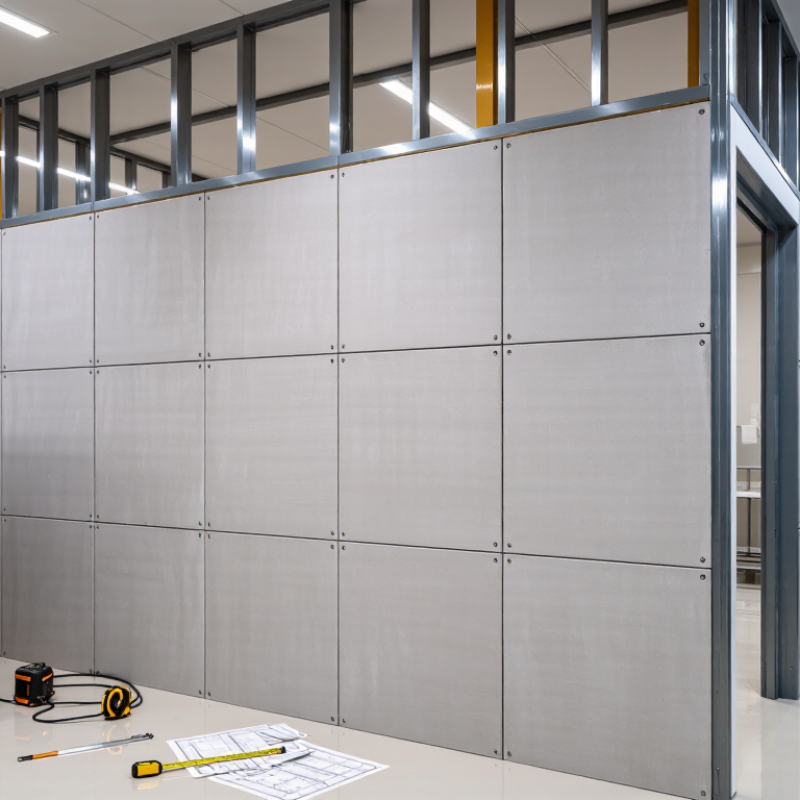
| Typical panel thickness | Barite-containing drywall panels | Often manufactured in thicknesses such as 12.5 mm or 15.9 mm; actual products and specifications vary | Panel thickness contributes to total attenuation. Multiple layers may be installed when the required shielding exceeds the performance of a single layer. |
| Equivalent shielding thickness | Lead-equivalent rating | Must be stated for a specified X-ray energy, beam condition, panel thickness, and test method; it is not a universal constant | Allows the panel to be compared with other shielding materials under defined conditions. A lead-equivalent value should not be applied outside its stated test conditions. |
| Attenuation factors | Radiation energy and workload | Required protection varies with tube voltage, use frequency, distance, occupancy, beam direction, and adjacent-room use | These factors determine the necessary shielding thickness and whether additional barriers are needed for primary or scattered radiation. |
| Wall joints | Staggered seams and overlapping layers | Joints should be offset between layers, with gaps and penetrations treated as potential weak points | Prevents direct radiation streaming through aligned seams and helps maintain a continuous protective barrier. |
| Electrical and service penetrations | Shielded outlets, conduits, ducts, and pipe openings | Penetrations require coordinated detailing; openings should not create an unshielded line of sight | Maintains continuity of the radiation barrier around building services and reduces localized leakage paths. |
| Door and viewing window | Shielded access and observation components | Must provide shielding appropriate to the same design conditions as the surrounding wall | Prevents doors, frames, and windows from becoming weaker areas in an otherwise adequately shielded room. |
| Installation characteristic | Drywall construction | Installed using framing, fasteners, joint treatment, and finishing methods similar to conventional board systems | Can simplify construction compared with site-applied heavy shielding materials, while still requiring careful handling because of the board’s greater weight. |
| Key performance limitation | Design-specific protection | No single barite-board thickness protects against every radiation source or imaging workload | A qualified shielding design is required to calculate barrier requirements and verify compliance with applicable radiation-safety regulations. |