


Who Are the Best Blown Film Machine Manufacturers in China?
China has become an important sourcing base for plastic film equipment, but choosing a supplier takes more than comparing prices. The best Blown Film Machine manufacturer depends on your materials, output targets, film width, and available factory space. A line designed for one production plan may not suit another.
This guide compares manufacturers through practical, checkable criteria: machine configuration, component specifications, quality-control procedures, installation support, spare-parts access, and customer references. Buyers should ask for clear technical drawings and confirm how quoted output figures were measured. If possible, inspect a running line or request a production test using similar resin and film requirements. Small details matter. A control screen is easy to photograph; stable film thickness over a full shift is harder to demonstrate.
Manufacturer profiles and marketing claims should be checked against current evidence, not treated as guarantees. Ask who handles commissioning, how operators receive training, and how quickly common parts can be supplied. Still, even a careful comparison has limits: factory visits may show only one machine, and references may reflect different operating conditions. That deserves a second look. The aim here is not to name a universal winner, but to help buyers identify capable Chinese suppliers and ask sharper questions before making a decision.
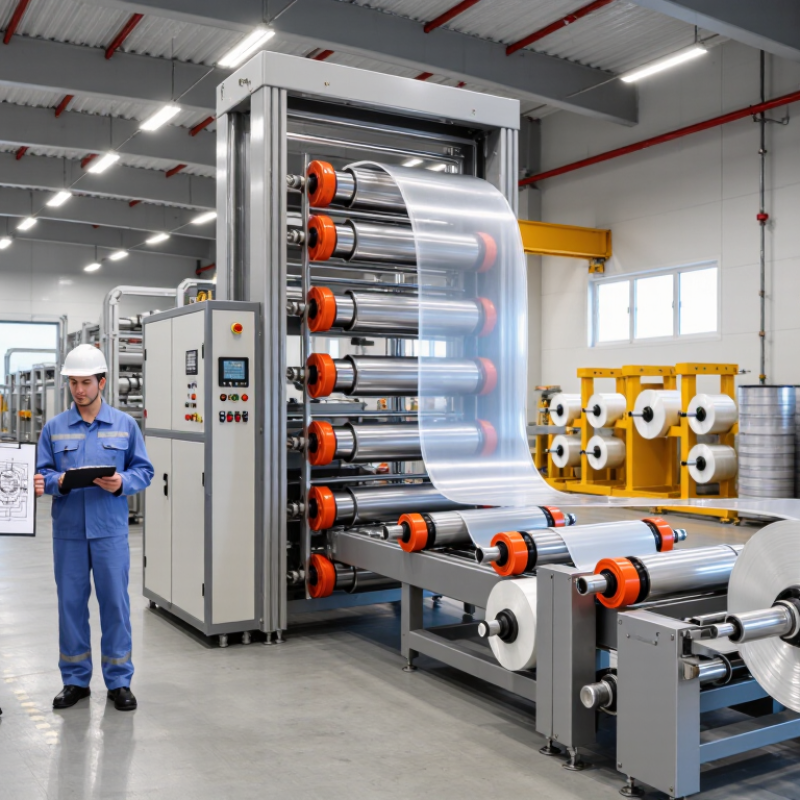
What Defines a Blown Film Machine Manufacturer in China?
A capable blown film machine manufacturer in China is defined less by catalog size than by proven process control. Its engineers should explain how screw design, die geometry, cooling rings, and haul-off speed affect bubble stability and film thickness. Ask for a trial with your resin and target gauge, then inspect edge trim, roll profile, and changeover time. Numbers matter.
Reliable production also depends on repeatable fabrication. Review die machining, electrical cabinet layout, safety guarding, and documented acceptance checks. Request sample rolls from a comparable line, with measured output, energy use, and thickness data—not only a maximum-speed claim. If results vary, the supplier should explain likely causes and practical adjustments. This is where experience shows.
After-sales support is equally important. Confirm commissioning, spare-parts lead times, remote diagnostics, and operator training in writing. A clear manual and labeled wiring can save hours during a fault. No supplier is perfect. Response quality matters. Buyers sometimes focus too heavily on purchase price; maintenance access and technical support can shape operating costs for years. Judge the manufacturer by evidence, not promises.

How 3-, 5-, and 7-Layer Lines Serve Different Film Structures
A 3-layer blown film line suits straightforward structures, such as a recycled or low-cost core between protective outer skins. Operators can adjust the layers for stiffness, sealing, and printability. A 5-layer line adds room for barrier materials, such as EVOH, with tie layers that bond them to polyolefins. That matters when a pouch must resist oxygen or retain aroma. Seven-layer lines offer finer control over thin functional layers and complex recipes. More layers aren’t always better.
The OECD’s Global Plastics Outlook (2022) estimates that packaging generated 142 million tonnes of plastic waste in 2019, or 40% of the total. This is a useful reminder: barrier performance matters, but so does the structure’s end-of-life pathway. Buyers should ask manufacturers for layer-ratio control, melt stability, die uniformity, and trial data using the intended resins. A neat machine specification is not proof of a stable film.
For a real comparison, request sample rolls and inspect gauge variation across the web, seal consistency, and barrier results. A 7-layer line can be the wrong choice if recipes rarely change or operators lack process support. That part is easy to overlook. The best fit depends on the target film, not the layer count alone.
How to Compare Output (kg/h), Die Width (mm), and Film Gauge (μm)
When comparing blown film machine manufacturers in China, treat output, die width, and film gauge as connected operating conditions. A quoted 180 kg/h means little without the resin type, layer structure, and thickness used during testing. Ask for a production trial with your intended material. Record output only after the bubble and winding have stabilized. Small details matter. Check whether the stated capacity is continuous output or a brief peak.
Die width is not the same as finished layflat width. Ask for the die diameter, expected blow-up ratio, and usable width range, then compare these with your bag or packaging specifications. For film gauge, request measurements across the web, not just a single average. A micrometer reading at the center can hide thin edges or uneven winding. Look for the test method and gauge tolerance in writing.
Compare machines under similar conditions: same resin, target gauge, and layer count. Otherwise, impressive numbers may not predict your actual production. Not always. A careful trial still cannot reproduce every shift, operator, or material batch, so leave room for variation. Ask the supplier to explain the limits of its figures, and keep the trial settings with the quotation for a fair comparison.
Which Suppliers Process LDPE, LLDPE, and HDPE Resins?
A capable blown film machine supplier should demonstrate stable processing of LDPE, LLDPE, and HDPE—not simply list them on a specification sheet. LDPE often needs careful bubble cooling to limit sticking and maintain a consistent gauge. LLDPE can improve toughness, but its melt behavior may require adjustments to screw design, output, and cooling. HDPE generally calls for a different temperature and bubble-control setup. One recipe rarely fits all three.
Ask suppliers to run your exact resin grades and blend ratios. Check the film roll for thickness variation, clarity, edge stability, and winding quality. Request output data at your target width and gauge, not just the machine’s maximum rate. Useful details include screw dimensions, die design, cooling-ring configuration, and temperature-control zones. Small differences matter. A polished brochure is not proof of a reliable production run.
A resin-specific trial can reveal problems that a showroom demonstration misses. Ask how operators adjust settings when resin lots vary, and whether the supplier records trial conditions. Be cautious when claims sound universal; film quality also depends on resin grade, additives, ambient conditions, and operator skill. Even experienced teams may need several adjustments. That is normal, but vague answers about process limits are not reassuring.
Who Are the Best Blown Film Machine Manufacturers in China? - Which Suppliers Process LDPE, LLDPE, and HDPE Resins?
Supplier-neutral guide: resin compatibility depends on the machine configuration, resin grade, film specification, and operating conditions. Use the questions below to compare suppliers and request application-specific proof.
| Resin | Typical blown-film considerations | Machine features to discuss | Common film applications | Evidence to request from a supplier |
|---|---|---|---|---|
| LDPE | Often offers good melt strength and bubble stability. Processing conditions vary by grade and film thickness. | Ask about the screw and die design, cooling system, thickness control, and the intended output range for the target grade. | Packaging film, liners, general-purpose bags, and films requiring flexibility. | A trial run using the proposed LDPE grade, with documented film width, thickness, output, and operating conditions. |
| LLDPE | Film properties and processing behavior depend on the comonomer and grade. Bubble control and cooling performance matter, especially for thin films. | Confirm suitability of the screw, die, air ring, and haul-off for the intended grade and layflat width. Ask whether blends with LDPE are required for the application. | Stretch and collation films, liners, refuse bags, and other tough flexible packaging films. | A production sample and test data for the specified LLDPE grade, blend ratio if applicable, film thickness, and mechanical properties. |
| HDPE | Typically produces stiffer films than LDPE and LLDPE. Grade-specific melt behavior and bubble stability should be assessed in a production trial. | Check that the extrusion and cooling configuration is designed for the target HDPE grade, film thickness, width, and required output. | T-shirt bags, grocery bags, liners, and other thin, relatively stiff films. | A machine trial with the specified HDPE grade, including stable operation records and finished-film thickness and width measurements. |
Comparison tip: Request a resin-specific trial, a written machine configuration, and clearly defined performance conditions. Output and film quality depend on resin grade, formulation, die size, film dimensions, cooling, and operating settings; published figures are not directly comparable unless these conditions match.
How ASTM D882 and ASTM D1709 Assess Film Strength and Impact
For blown-film producers, a strong-looking roll is not proof of reliable performance. ASTM D882 measures tensile properties of thin plastic sheeting, including tensile strength and elongation at break. The standard covers films under 1 mm thick. Results depend on specimen width, grip spacing, and test speed, so buyers should compare samples tested under matching conditions. Small details matter. A poorly aligned specimen can skew the reading.
Impact needs a different test. ASTM D1709 reports the dart mass that causes failure in 50% of tested specimens. Method A uses a 38.1 mm dart head dropped from 0.66 m; Method B uses a 50.8 mm head from 1.52 m. These settings, specified by ASTM International, help labs produce comparable impact data. For machine qualification, ask for both tensile and dart-impact results from film made at the intended thickness and line speed. One limitation remains: lab tests cannot fully reproduce cold storage, sharp package contents, or rough handling. I would treat test data as a starting point, not a guarantee.
Who Are the Best Blown Film Machine Manufacturers in China?
How ASTM D882 and ASTM D1709 assess film strength and impact
ASTM D1709 specifies a 0.66 m drop height for Method A and a 1.52 m drop height for Method B. These are test conditions, not film performance results; impact resistance is determined from the dart mass that causes failure. ASTM D882 evaluates tensile properties such as tensile strength and elongation. Ask film-machine suppliers for results from both tests on comparable film samples before comparing performance.
Article Source:
Siemensstraße 13-15
47608 Geldern
NRW Deutschland
Mail: sale@atmmachinesolutions.com
Head office:
+49 (0) 2831 91021-20
Fax:
+49 (0) 2831 91021-99
SUPPORT and INFO
from 3 p.m. to 6 p.m:
+49 (0) 2831 91021-60
( please ring for a long time )
Monday to Friday
8.00 – 12.30
and 13.00 – 15.00
Visit / collection by appointment only!
➣ Sign up for our newsletter
Benefit from a 20% discount, don’t miss any events and always stay up to date.
To access the actual content, click on the button below. Please note that data will be passed on to third-party providers.
More information