How to Choose the Best Portable Fire Monitor
The right Portable Fire Monitor is not simply the unit with the greatest advertised flow. It must match the water supply, crew, vehicle, and hazards expected at the site. A monitor that performs well on a test pad may feel awkward beside a narrow access road or in a crowded industrial yard. Fit matters.
This guide explains how to compare flow and pressure ratings, nozzle options, operating reach, mounting style, materials, and ease of transport. Check manufacturer specifications against the pump and hose system you will actually use. A mismatch can reduce performance, even when each component looks capable on its own. Consider setup time, control placement, and whether operators can adjust the stream while wearing protective equipment. Small things count.
Durability and maintenance deserve equal attention. Look for clear inspection guidance, accessible service parts, and construction suited to heat, moisture, and repeated handling. Ask suppliers for test data and confirm what their stated ratings mean; marketing language can leave gaps. Training also matters, because a powerful monitor is not automatically easy to control. This is easy to overlook. The best choice balances dependable output with practical handling, rather than chasing one impressive number. Conditions vary, so use this guide as a decision framework and verify details with a qualified fire-protection professional and the equipment manufacturer. A careful comparison can help prevent an expensive mismatch.
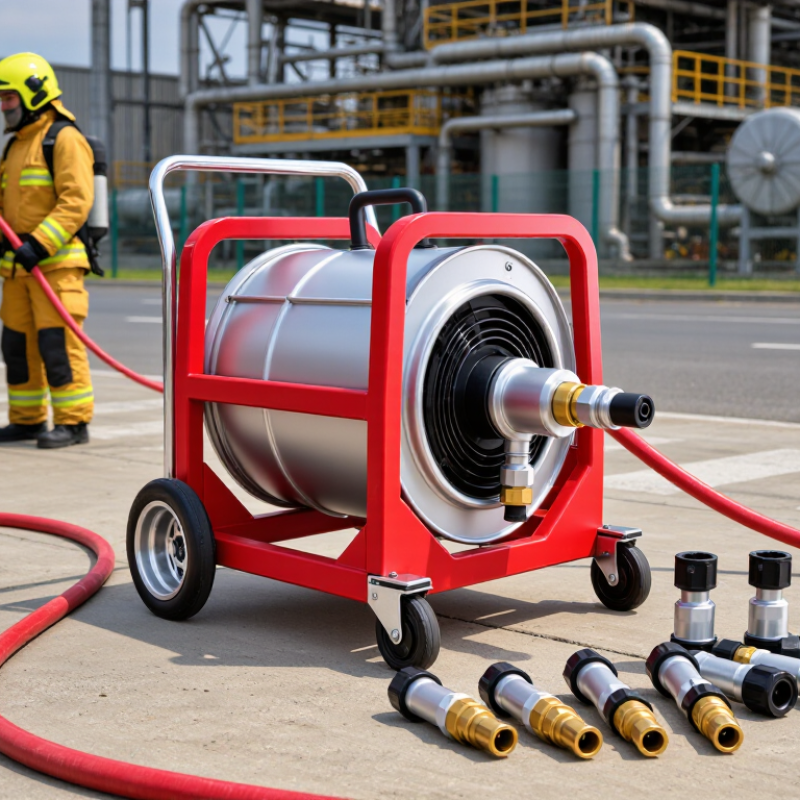
Portable Fire Monitors: Types, Components, and Typical Flow Ratings
Portable fire monitors are commonly grouped as fixed-base, folding-leg, and oscillating models. Published equipment data sheets often list flows around 500–1,250 gallons per minute (1,900–4,700 liters per minute), typically at stated inlet pressures such as 100 psi. Treat these as representative ratings, not universal limits. NFPA 1964 sets performance requirements for spray and foam-water nozzles; it does not assign one flow rating to every monitor. Always compare the monitor and nozzle specifications together.
Key components include the inlet, waterway, swivel or elevation controls, stabilizing base, and nozzle. A wide base and secure restraint help resist reaction forces; smooth controls make aiming easier when the line is charged. Flow alone can mislead. A high-rated unit may demand more supply than the hose or pump can deliver, reducing its actual reach and stream quality.
Tips: Check the rated flow at the intended pressure, then confirm inlet compatibility and setup requirements. Test handling with the hose connected, if practical. Small details matter. Some field conditions are messy, so leave room for judgment rather than trusting a catalog number alone.
Match Flow and Pressure to the Job: 1 US gpm Equals 3.785 L/min
A portable fire monitor is useful only when its flow and pressure match the job. Flow is often listed in US gallons per minute, or gpm. For a quick conversion, multiply US gpm by 3.785 to get liters per minute. A 100 gpm rating equals about 379 L/min. Check units carefully.
Flow tells you how much water moves; pressure helps determine whether it reaches the target effectively. A monitor’s rated flow may depend on nozzle choice and inlet pressure, so compare figures under similar conditions. Hose length, bends, elevation, and water-supply limits can reduce pressure at the monitor. A setup that looks adequate on paper may deliver less at the nozzle.
Picture a crew positioning a monitor beside a warehouse wall: a long hose run and a slight uphill rise can change the available pressure. Review the pump curve and equipment specifications, then confirm performance with suitable gauges during a controlled test. Numbers are helpful, but field measurements matter. I would not treat a converted flow figure as a guarantee; it is a planning estimate that needs checking against the actual setup.
Evaluate Reach, Nozzle Patterns, and Reaction Force at Rated Pressure
A portable fire monitor’s reach should be judged at its rated pressure, not from a catalogue’s best-case distance. NFPA 1964 provides a framework for evaluating nozzle performance, including flow and pressure. Ask for test conditions behind any reach figure. Wind, elevation, hose movement, and stream breakup can shorten useful reach. Details matter.
Pattern choice changes how water behaves. A straight stream generally carries farther, while a wider fog pattern covers more area but may lose reach sooner. Test both patterns at the intended flow and rated pressure. Watch the stream’s edge. Does it stay coherent, or scatter before reaching the target? This practical check is easy to overlook.
Reaction force deserves equal attention. Fire-service hydraulics commonly estimates nozzle reaction as 0.0505 × flow in gallons per minute × the square root of pressure in psi, as described in IFSTA’s Essentials of Fire Fighting. At 250 gpm and 100 psi, that is about 126 pounds-force. That is a calculation, not a guarantee of handling safety. Mounting, hose layout, and operator position also affect control. A monitor that reaches farther may still be a poor choice if its reaction force exceeds the crew’s comfortable operating limit. Test the full setup, not just the nozzle.
Compare Portability, Setup Time, Materials, and Connection Compatibility
A portable fire monitor should be easy to move without becoming difficult to control. Compare its weight, footprint, and carrying points against the routes crews actually use. A unit that fits through a doorway but cannot be lifted safely is not truly portable. Check its rated flow and operating pressure too; compact size alone says little about performance. Balance matters.
Setup time can affect how quickly a trained crew gets water flowing. Look for clear controls, stable legs, and connections that can be reached while wearing protective gloves. Review the manufacturer’s setup instructions, then practice in a safe training area. Materials matter in wet, rough environments: corrosion-resistant metals and durable seals may reduce wear, but inspect them regularly. Confirm inlet size, thread type, and coupling standard match the hose and water supply on site. Never assume similar-looking fittings are compatible. Small differences matter.
Tips: Measure doorways and storage spaces before choosing. Verify flow and pressure requirements with a qualified fire-safety professional. Keep the manual nearby, and schedule inspections. The best fit may still involve a trade-off; write down what matters most before comparing models.
Verify Test Data, Applicable Standards, and Manufacturer Specifications
Start with the test report, not the product brochure. Check that the tested unit matches the monitor’s exact model and configuration. A certificate covering a product family may not cover every nozzle or pressure option. Look for the test date, methods, conditions, and laboratory details. Where relevant, confirm the laboratory’s accreditation covers the tests performed. Numbers matter. Compare flow rate, operating pressure, and reach under stated conditions; a range without test conditions is hard to judge.
Next, identify the standards that apply to your intended use and location. Confirm their current editions and whether the document is a test report, certification, or declaration. These are not interchangeable. Then compare the manufacturer’s specifications with the test data. Check inlet size, permitted pressure, materials, weight, and connection compatibility. A monitor rated for a certain flow may require a supply your vehicle or hose cannot provide. Ask for clarification when figures conflict, and keep the written response with the equipment records. Test sheets can be messy, and a small mismatch is easy to overlook. I would not treat an unexplained discrepancy as proof of failure, but I would resolve it before selection.
How to Choose the Best Portable Fire Monitor
Verify test data, applicable standards, and manufacturer specifications before comparing products.
This buyer-checklist chart counts suggested evidence checks, not product test results. Confirm each monitor’s flow, operating pressure, reach, applicable standard and edition, and model-specific documentation using current test reports and manufacturer specifications.