


How to Choose the Best Reflow Machine for PCB Assembly?
Choosing the right Reflow Machine is not a matter of buying the largest oven or the newest touchscreen. It means matching the machine to your boards, solder paste, components, and production volume. A dense board with large thermal masses may need a different profile from a small, simple assembly. The difference shows up in real details: uneven joints, tombstoning, or a board that exits the oven still warm.
Bob Willis, a recognized electronics assembly process specialist, has long emphasized process control in soldering. A practical way to express that guidance is: “Choose the machine around the process window, not the sales brochure.” Treat this as a guiding principle, not a verbatim quotation. The useful question is whether the oven can hold a stable profile across your actual board width and load. Look closely at zone control, conveyor consistency, nitrogen needs, maintenance access, and profile measurement. Small variations matter.
Your decision should also reflect the work ahead. Ask suppliers to run representative boards, then review the temperature curve and inspect the joints. A machine that performs well on a demonstration board may behave differently with your own layout. That is easy to overlook. And specifications alone do not settle everything; operator skill and upkeep matter too. This guide will help you compare Reflow Machine options with practical criteria, spot trade-offs, and choose equipment that supports repeatable PCB assembly without paying for capacity you may never use.
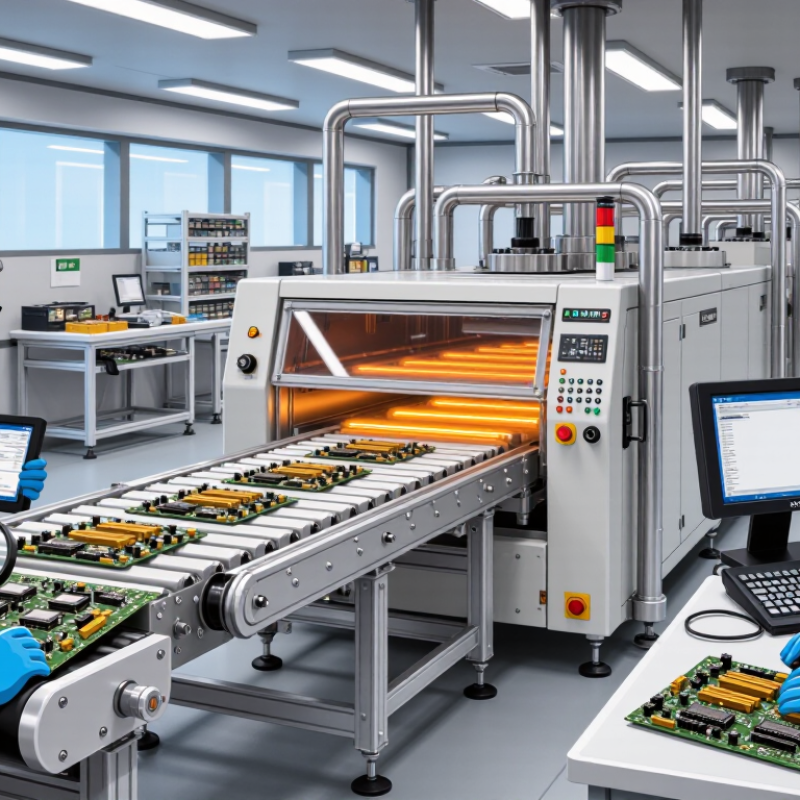
Define PCB Assembly Requirements and Production Goals
Before comparing reflow machines, define the boards and output you need to process. Record PCB dimensions, panel layout, component mix, and the heaviest parts. A dense board with large connectors may heat differently from a small, lightly populated one. Note the solder alloy and the temperature limits of sensitive components. These details help determine conveyor width, heating-zone capacity, and cooling needs.
Tips: Collect several real production boards, not just the easiest sample. Ask operators where heating or handling problems occur. Set a target throughput in boards per hour, then check whether it includes loading, inspection, and changeovers. Small details matter.
Production goals should reflect both current demand and realistic growth. Consider shift patterns, product changeovers, available floor space, and the ventilation and utilities already in place. Ask how the machine records profiles and supports repeatable adjustments; useful records make troubleshooting less dependent on memory. A first estimate is rarely perfect. Revisit it with production and process staff before choosing equipment. A spreadsheet helps, but it cannot capture every awkward board or rushed changeover.

Compare Reflow Oven Types and Heating Technologies
Reflow machines generally fall into batch and inline categories. Batch ovens suit prototypes, repair work, and low-volume runs; boards are loaded in small groups. They cost less to integrate, but each cycle includes loading and cooling time. Inline ovens keep boards moving through heating zones, supporting repeatable production at higher volumes. They need more floor space and careful line balancing. That trade-off matters.
Heating method changes the process window. Forced-convection ovens circulate heated air around the board, helping warm components of varied sizes more evenly. This suits many mixed assemblies, though poorly tuned airflow can shift very light parts. Infrared systems heat surfaces quickly, but shadows and differences in component color or mass can create uneven results. Vapor-phase systems transfer heat through condensing vapor and can limit peak temperature, yet fluid handling and maintenance add complexity. No method is automatically best. Not always.
Compare more than the advertised zone count. Check usable board width, temperature uniformity, conveyor speed, exhaust needs, and recipe storage. Then profile a real board with thermocouples on a large connector, a small passive part, and a heat-sensitive component. Review ramp rate, soak, time above liquidus, and peak temperature against solder-paste guidance. A shiny joint alone proves little. A lower-cost oven may work well, but only with careful tuning and consistent maintenance. If the board mix changes often, flexibility may matter more than maximum throughput.
Evaluate Temperature Control, Capacity, and Process Features
A reflow machine should hold a repeatable profile across the whole PCB, not merely reach a target temperature. IPC-7530A, the industry guideline for reflow process profiling, emphasizes measuring temperatures on the assembled board. For common SAC lead-free solder, the liquidus is about 217°C; the required peak and time above liquidus still depend on the paste and component limits. Check both a heavily populated board and a small, lightly loaded one. A single sensor can miss a cold corner.
Small details matter.
Capacity is more than the conveyor’s advertised speed. Compare usable belt width, board clearance, zone count, and actual boards per hour under a representative load. Then profile boards at production speed, with thermocouples near large connectors, fine-pitch components, and board edges. IPC-7530A supports this measurement-led approach, rather than assuming one profile suits every assembly.
Features such as recipe storage, alarm logging, and conveyor-speed control help operators reproduce settings between shifts. Nitrogen may improve wetting in some processes, but it adds operating cost and should be justified by trials. A polished profile can still mislead if the test board is unlike daily production. Include maintenance access and calibration checks in the evaluation; those practical details are easy to overlook.
Assess Energy Use, Maintenance, Safety, and Total Cost
Energy use is easy to overlook when comparing reflow machines. Ask suppliers for power consumption during warm-up, steady production, and standby, not just peak ratings. Compare these figures using your actual shift length and board mix. Small losses add up. Check whether insulation, zone controls, and idle settings suit your production schedule. Energy figures from different test conditions may not be directly comparable, so treat them as estimates.
Maintenance affects both uptime and cost. Ask how often filters, conveyor parts, and temperature sensors need inspection or replacement. Confirm that technicians can reach service points without awkward disassembly. Keep access clear. Safety deserves the same scrutiny: inspect guarding, emergency stops, hot-surface protection, and exhaust connections before purchase. Then calculate total cost across the machine’s expected service life, including energy, spare parts, labor, training, and downtime. A low purchase price can hide expensive maintenance or slow recovery after a fault. No estimate is exact; production changes, and spreadsheets can miss small delays between batches. Use realistic operating data where possible, and leave room for uncertainty.
How to Choose the Best Reflow Machine for PCB Assembly? — Assess Energy Use, Maintenance, Safety, and Total Cost
| Evaluation factor | Compact line (typically 4–6 heating zones) | Mid-size line (typically 8–10 heating zones) | High-throughput line (typically 10–12+ heating zones) |
|---|---|---|---|
| Typical application | Prototypes, laboratories, and lower-volume production | Regular production with a mix of board sizes and product types | High-volume production or processes needing greater profile flexibility |
| Indicative installed power | About 20–40 kW | About 40–80 kW | About 70–140 kW or more |
| Indicative running power | Roughly 8–20 kW during steady operation | Roughly 15–40 kW during steady operation | Roughly 30–70 kW during steady operation |
| Energy-use assessment | Check warm-up time, standby settings, insulation, and energy use at the planned workload. | Compare measured kWh per operating hour or per board at similar throughput and profiles. | Evaluate heat recovery, idle-mode controls, exhaust requirements, and energy use at rated production. |
| Maintenance workload | Generally fewer zones and simpler access; inspect conveyor, fans, filters, and seals regularly. | Plan routine cleaning and checks across more heaters, fans, sensors, and exhaust components. | Allow for more extensive cleaning, spare parts, planned downtime, and maintenance labor. |
| Maintenance checks to confirm | Ask how to clean the conveyor and inspect thermocouples, fans, and exhaust filters. | Check access for routine cleaning, calibration, fan replacement, and flux-residue removal. | Confirm service access, maintenance intervals, parts availability, and expected repair response time. |
| Safety features | Verify over-temperature protection, guarded hot surfaces, emergency stop, and clear operating instructions. | Also review door or access interlocks, electrical protection, and safe procedures for jams and cleaning. | Assess local exhaust connection, fire-risk controls, lockout procedures, and safe access for service work. |
| Process and capacity checks | Confirm usable belt width, board clearance, and whether the required thermal profile is achievable. | Test representative boards and verify profile repeatability across the planned product mix. | Match belt width and speed to line takt time; validate profile stability at production loading. |
| Total-cost considerations | Lower initial cost may be offset if capacity is insufficient or the machine needs frequent changeovers. | Compare purchase, installation, energy, maintenance, exhaust, training, and downtime costs. | Higher purchase and facility costs can be justified when throughput and uptime needs are consistently high. |
| Best-fit decision | Choose when demand is modest and the required board profile fits the available process window. | Choose when flexibility, dependable output, and operating cost need to be balanced. | Choose when verified production demand requires greater capacity and the facility supports it. |
Note: Power figures are broad indicative ranges, not guaranteed specifications. Actual consumption depends on oven design, board loading, setpoints, conveyor speed, insulation, exhaust flow, and operating conditions. Request comparable measured data and a process trial before purchase. A practical total-cost estimate is: purchase and installation + energy + maintenance and spare parts + exhaust and facility costs + training + expected downtime.
Verify Machine Performance with Profile Testing and Trial Runs
A reflow machine should be judged by what it does to your actual boards, not just by its display settings. Ask for a profile test using a representative assembly, with thermocouples attached to both large components and heat-sensitive areas. Watch the ramp rate, soak time, peak temperature, and time above liquidus. These readings show whether the solder joints receive enough heat without stressing nearby parts. Small boards can heat quickly; dense boards may behave differently.
Run several trials with the same board, paste, and conveyor settings. Record the profile and inspect joints for bridging, poor wetting, or uneven results. Then repeat the test with a heavier or more densely populated assembly if your production mix varies. One run is not enough. Compare the measured temperatures with the solder paste supplier’s process window, and check whether the machine returns consistent results after a brief production run.
A useful trial also reveals practical details: board loading, alarm response, and how easily operators can adjust settings. No test perfectly predicts every shift or component variation. That limitation matters. Keep the data, note any changes, and ask the supplier to explain unexplained temperature swings before choosing the machine.
Article Source:
Siemensstraße 13-15
47608 Geldern
NRW Deutschland
Mail: sale@atmmachinesolutions.com
Head office:
+49 (0) 2831 91021-20
Fax:
+49 (0) 2831 91021-99
SUPPORT and INFO
from 3 p.m. to 6 p.m:
+49 (0) 2831 91021-60
( please ring for a long time )
Monday to Friday
8.00 – 12.30
and 13.00 – 15.00
Visit / collection by appointment only!
➣ Sign up for our newsletter
Benefit from a 20% discount, don’t miss any events and always stay up to date.
To access the actual content, click on the button below. Please note that data will be passed on to third-party providers.
More information