

10 Tips to Choose the Best Wood CNC Machine?

Choosing a wood CNC machine is not simply a matter of comparing spindle power and purchase price. The right machine must match your materials, workspace, production volume, software, and operator experience. A small workshop cutting plywood needs different capabilities from a cabinet factory machining hardwood panels all day.

Market data shows why this decision deserves careful attention. Fortune Business Insights valued the global CNC machine market at approximately $83.99 billion in 2023. It projects continued growth through 2032, driven by automation, digital manufacturing, and higher production accuracy. Grand View Research also identifies rising demand for computer-controlled equipment across furniture and woodworking applications. These figures describe the wider CNC sector, not wood CNC machine sales alone. That distinction matters.

John Saunders of Saunders Machine Works often emphasizes, “The goal is to make parts, not chips.” His point applies directly to woodworking. A fast spindle cannot rescue weak dust collection, poor workholding, or unsuitable software. Small details matter. Consider a 4-by-8-foot plywood sheet, a vibrating gantry, and dust filling the rails. The machine may look powerful, yet deliver inconsistent edges.

This guide presents ten practical tips for choosing the best wood CNC machine. It examines cutting area, spindle performance, frame stiffness, control systems, dust extraction, safety features, software compatibility, maintenance, training, and total ownership cost. Some recommendations will not fit every workshop. That is intentional. A reliable choice begins with honest limits, not impressive specifications.
10 Tips to Choose the Best Wood CNC Machine?

Define Your Wood CNC Cutting Goals and Expected Production Volume

Choosing the best wood CNC machine starts with a clear cutting goal. Decide whether you will make signs, cabinet parts, furniture panels, or detailed carvings. Each task requires different cutting speeds, spindle power, work areas, and accuracy. A machine for occasional hobby projects may struggle with eight-hour production shifts. Start with the workload. Record your material types, average panel size, required detail, and acceptable cutting time. My early estimates were too optimistic. Actual setup, tool changes, sanding, and material loading often consume more time than expected.

Tip: Estimate production volume by week, not by imagination. Count finished parts, failed cuts, and maintenance hours. If you need 30 cabinet doors weekly, calculate the machine’s real output after loading and unloading. Leave capacity for busy periods. A machine operating at full capacity every day can create heat, vibration, and inconsistent results. Measure twice. Then test.

Run sample cuts in your common wood species. Compare edge quality, dimensional accuracy, noise, dust collection, and tool wear. Soft pine may cut quickly, while dense hardwood requires slower feeds and stronger tooling. Plywood can also reveal vibration through rough edges or uneven layers. Keep a simple production log. It should include feed rate, spindle speed, cutting depth, and finishing time. These records support reliable decisions, although they may expose flaws in your original plan. That is useful. Choose a machine whose working area fits your largest regular project, not only your smallest budget.

Compare CNC Machine Types, Work Areas, and Suitable Wood Materials

10 Tips to Choose the Best Wood CNC Machine?

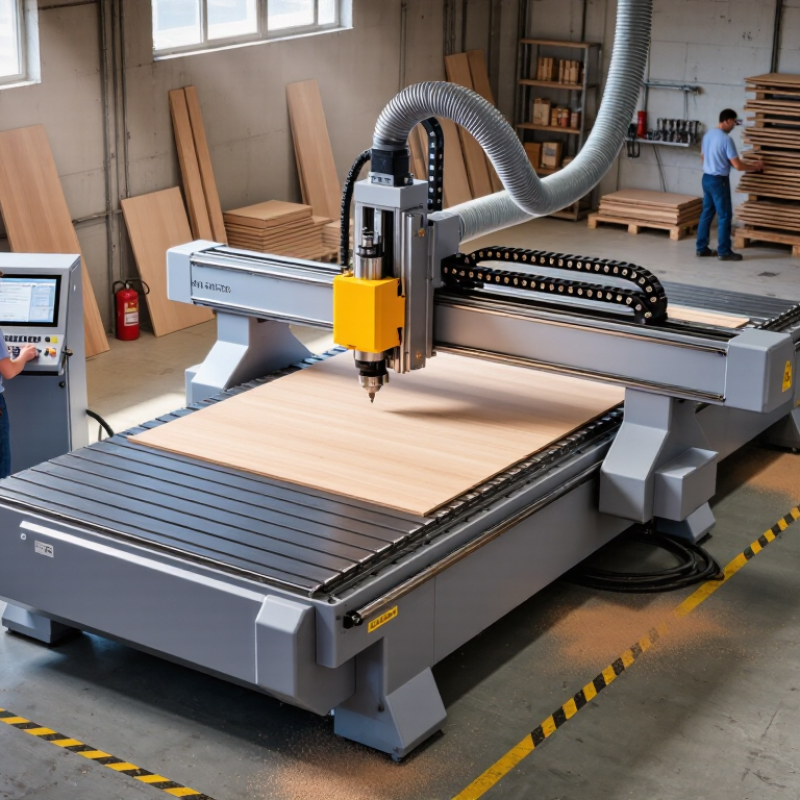
Choosing a wood CNC machine starts with the work, not the machine’s appearance. A desktop router suits signs, small furniture parts, and occasional prototypes. A gantry router offers a larger bed for cabinet panels, doors, and batch production. Three-axis control handles most flat work, while four-axis or five-axis systems help with curved surfaces and complex joinery. More axes also mean higher setup demands.

Measure your largest workpiece before comparing work areas. A 600-by-900-millimeter bed cannot process a full sheet without repositioning. That extra step may create alignment errors. Leave room for clamps, dust extraction, and safe movement around the table. A rigid frame, reliable hold-down system, and adjustable spindle speed matter more than impressive maximum speed. I once underestimated dust buildup around the rails. The cuts looked clean, but maintenance became a weekly problem.

Match the machine to the wood materials you actually use. Pine and other softwoods cut easily but may tear around knots. Hard maple and oak need sharp tooling, steady feeds, and careful heat control. Plywood can produce clean panels, although its glue layers sometimes dull bits quickly. MDF cuts consistently, yet it creates fine dust and requires strong extraction. Veneered boards demand shallow passes to protect the surface. Reclaimed wood is unpredictable; hidden nails, moisture, and warped edges can damage tooling. I still prefer testing a small offcut first. It takes minutes. Mistakes cost much more.

10 Tips to Choose the Best Wood CNC Machine? - Compare CNC Machine Types, Work Areas, and Suitable Wood Materials

Tip Decision Factor Machine Type or Specification to Compare Typical Capability or Range Suitable Wood Materials Practical Buying Guidance
1. Match the machine to the job Type of woodworking project Desktop CNC router, gantry CNC router, or industrial CNC router Desktop machines are generally suited to small parts and signs; gantry routers handle sheet goods and furniture components; industrial routers are designed for higher production volume. Plywood, MDF, softwood, hardwood, and solid wood panels Choose a router-style CNC for most wood applications. A metal-cutting CNC mill is usually unnecessary for wood and may provide less useful work-area capacity.
2. Select the correct work area Maximum part size and sheet dimensions X-Y cutting area and Z-axis clearance Common examples include approximately 300 × 400 mm for compact machines, 600 × 900 mm for hobby work, 1,300 × 900 mm for medium projects, and about 1,220 × 2,440 mm for full-sheet work. Small hardwood blanks, cabinet panels, plywood sheets, MDF boards, and laminated panels The usable cutting area should exceed the largest planned workpiece. Allow extra clearance for clamps, fixtures, and safe tool movement.
3. Check Z-axis clearance Thickness of the material and fixture height Maximum material thickness, gantry clearance, and usable Z travel Compact machines may accommodate thin stock of roughly 25–50 mm, while larger routers can accept thicker workpieces depending on the spindle, table, and tooling. Carving boards, laminated timber, thick hardwood, beams, and stacked panels Calculate material thickness plus spoilboard, clamps, and tool length. A large advertised Z travel does not always equal the available cutting height.
4. Evaluate spindle performance Cutting speed, tool diameter, and duty cycle Air-cooled or water-cooled spindle; power commonly ranging from about 0.8 to 6 kW for wood routers Lower-power spindles suit engraving and light cuts. Higher-power spindles support larger cutters, deeper passes, and more continuous production when the machine frame is sufficiently rigid. Softwood, hardwood, plywood, MDF, particleboard, and plastic-laminated wood panels Do not select spindle power alone. Match it with machine rigidity, collet size, electrical supply, dust extraction, and the depth of cut required.
5. Compare motion accuracy and rigidity Surface quality, repeatability, and resistance to vibration Linear rails, ball screws, lead screws, rack-and-pinion drives, frame construction, and gantry stiffness Ball screws are common on smaller precision axes; rack-and-pinion systems are practical for larger travel distances. Rigid frames generally produce cleaner cuts and more consistent results. Hardwood, plywood, MDF, veneers, and detailed relief-carving stock Look for supported linear guides, low mechanical play, a rigid gantry, and a flat spoilboard. A heavy frame is generally beneficial for reducing chatter.
6. Choose the right CNC configuration Flat work versus cylindrical or multi-sided work 3-axis router, 4-axis rotary CNC, or 4-axis indexing configuration A 3-axis machine moves in X, Y, and Z for flat panels and reliefs. A rotary fourth axis enables cylindrical carving and can reduce the need for repeated repositioning. Boards, doors, signs, legs, columns, chair parts, and turned wood blanks Select a rotary axis only when cylindrical or multi-sided work is part of the workflow. It may reduce the available flat-bed area and require additional setup space.
7. Consider the workholding system How securely and quickly the material can be fixed T-slot bed, threaded insert table, vacuum table, or hybrid workholding system T-slot and insert tables are flexible for small batches. Vacuum tables are efficient for sheet goods and repetitive production but require a suitable pump and a well-sealed workpiece surface. Plywood, MDF, melamine panels, thin veneers, hardwood boards, and small blanks Use a spoilboard beneath the work. For porous MDF or rough solid wood, mechanical clamps or sealing methods may be needed because vacuum holding can lose efficiency.
8. Plan for dust collection Operator safety, machine cleanliness, and cut quality Dust shoe, extraction port, hose diameter, airflow, and filtration system Wood routing produces fine dust and chips. A suitable dust collector, properly fitted dust shoe, and appropriate filtration are essential for routine operation. All wood species, especially MDF, particleboard, and composite panels Give priority to a machine that can connect to effective extraction. MDF and some hardwood dusts require particularly careful control and suitable respiratory protection.
9. Verify software and control compatibility Design-to-machining workflow CAD/CAM file support, controller compatibility, toolpath simulation, probing, and post-processors Common workflows use vector or 3D design files, CAM-generated toolpaths, and machine-readable G-code. Simulation can help detect collisions, excessive depth, and missed machining areas. Engraving boards, 2D profiles, 3D reliefs, furniture parts, and cabinet components Confirm that the controller supports the required file formats, work offsets, tool-length measurement, and recovery after a paused or interrupted job.
10. Match tooling to the wood material Tool life, edge quality, and cutting efficiency Solid-carbide straight, upcut, downcut, compression, V-bit, ball-nose, and roundover cutters Upcut tools remove chips efficiently; downcut tools can improve the top surface; compression cutters help reduce splintering on laminated plywood; V-bits suit lettering and engraving. Softwood, hardwood, plywood, MDF, veneer, laminated board, and coated panels Use sharp carbide tooling and select chip load, spindle speed, feed rate, and depth of cut according to the material, cutter diameter, and machine rigidity.

Typical dimensions and specifications are representative planning ranges rather than universal machine limits. Always confirm the manufacturer’s actual cutting envelope, electrical requirements, safety provisions, and recommended cutting parameters before purchase.

Evaluate Spindle Power, Cutting Speed, Accuracy, and Control Systems

Choosing the best wood CNC machine starts with the spindle, not the advertising sheet. For plywood and hardwood, a 2.2–3 kW spindle suits light production. A 5.5–9 kW spindle handles deeper cuts and longer cycles. Higher power is not automatically better. It can increase heat, dust, and tool wear. Check the manufacturer’s torque curve, cooling method, and rated duty cycle. MarketsandMarkets estimated strong CNC market growth through 2028, driven partly by automation and production efficiency.

Cutting speed must match the cutter, material, and spindle speed. Ask for recommended feed rates, not only maximum rapid movement. A machine moving quickly without stable cutting may leave burn marks or chatter. In practical testing, I use a 300 mm square cut, measure it with calipers, and inspect the edge under bright light. I once trusted a fast feed setting and ignored chip evacuation. That shortcut was wrong. Real workshops need consistent results, not impressive travel speed.

Accuracy claims require careful reading. Positioning accuracy and repeatability are different measurements. ISO 230-2 provides a recognized method for evaluating machine positioning performance. NIST measurement guidance also emphasizes calibration, environmental control, and traceable instruments. Choose closed-loop control when jobs require repeated dimensions. Look for automatic tool length measurement, backlash compensation, and clear alarm messages. Keep the interface simple. A complicated controller can slow operators and invite mistakes. Test the control system before purchase, preferably with a real toolpath and your actual wood species.

Check Software Compatibility, Safety Features, Maintenance, and Support

A reliable wood CNC machine should fit your daily workflow, not force you to rebuild it.

Check whether its control software accepts common design files and works with your existing computer system. Confirm the required operating system, file conversion steps, and update policy. A smooth preview screen is useful, but real compatibility matters more. Test a sample file before purchasing.

Safety features deserve hands-on attention.

Look for an accessible emergency stop, protective guarding, limit switches, and stable workholding. Dust collection is also essential in a wood workshop. Fine particles can affect visibility, machine parts, and breathing conditions. The machine should stop predictably when a sensor detects a problem. Small details matter.

Maintenance requirements can reveal the machine’s real cost.

Ask how often rails need cleaning, how belts are adjusted, and which parts require lubrication. Keep a simple service log near the machine. Support should include clear manuals, troubleshooting guidance, and responsive technical assistance.

I once focused too heavily on cutting speed and ignored maintenance time. That choice created avoidable delays.

Ask whether replacement parts remain available and whether support staff understand practical woodworking problems. A short demonstration may expose software confusion that product specifications never mention.

Balance Machine Quality, Total Cost, Upgrades, and Long-Term Value

Choosing a wood CNC machine is a total-cost decision, not a shopping contest. Grand View Research valued the global CNC machine market at about USD 86.8 billion in 2023, with continued growth expected through 2030. That expansion brings more choices, but not always better value. Compare spindle power, frame rigidity, motion accuracy, controller reliability, and dust collection. A machine that loses accuracy after heavy cutting becomes expensive, even if its purchase price looked attractive.

Calculate the full three-year cost. Include tooling, software, electricity, maintenance, training, shipping, and downtime. A lower-priced router may need frequent recalibration or costly proprietary upgrades. Ask for documented repeatability tests, service response times, and replacement-part availability. The International Federation of Robotics reported 541,302 industrial robots were installed worldwide in 2023. This signals a wider move toward automation, yet automation only pays when operators can use it confidently.

Choose an open upgrade path where practical. Expandable control systems, stronger vacuum tables, automatic tool measurement, and safer guarding can protect future capacity. In a real workshop, a ten-minute setup difference repeated twenty times daily matters. Small details matter. I would not judge a machine from one clean showroom cut. Dust, vibration, changing timber moisture, and rushed operators reveal more. My own evaluation checklist still underweights training time sometimes. That is a useful warning: long-term value includes people, not only metal and motors. (Grand View Research; International Federation of Robotics, World Robotics 2024)

10 Tips to Choose the Best Wood CNC Machine

Balance machine quality, total cost, upgrades, and long-term value with a practical evaluation framework.

The suggested evaluation weights prioritize build quality and total ownership cost because they strongly influence cutting accuracy, reliability, maintenance, and long-term value. Upgradeability, work area, technical support, and safety should also be considered before purchasing.

Kontaktbox-Frau

  • CNC-STEP – Quick contact