


Top 10 Ion Exchange Resin Manufacturers Worldwide

Ion Exchange Resins quietly support essential work in water treatment, food processing, chemical production, and power generation. Inside a treatment vessel, tiny resin beads capture selected ions as water flows past. Their performance depends on more than capacity. Resin chemistry, bead strength, operating conditions, and regeneration needs all matter.

Friedrich G. Helfferich, author of the foundational book Ion Exchange, described the process simply: “Ion exchange is a reversible process.” That principle still guides resin selection. But real systems are less tidy than a definition. Feedwater may contain competing ions, and operating costs can shift when regeneration becomes frequent.

This guide to the Top 10 Ion Exchange Resin Manufacturers Worldwide offers a practical starting point for comparing established suppliers. It considers product range, technical support, manufacturing reach, and experience across applications. Company claims deserve careful checking. Specifications can look similar on a datasheet, yet bead uniformity or service support may differ at the plant.

There is no universal winner. A resin suited to a municipal water facility may not fit a high-purity process line. Buyers should confirm performance data, quality documentation, and local technical assistance before making a decision. Small details matter. And some comparisons remain imperfect, because public information does not reveal every customer result or operating condition. The list is meant to inform, not replace a qualified engineering assessment.
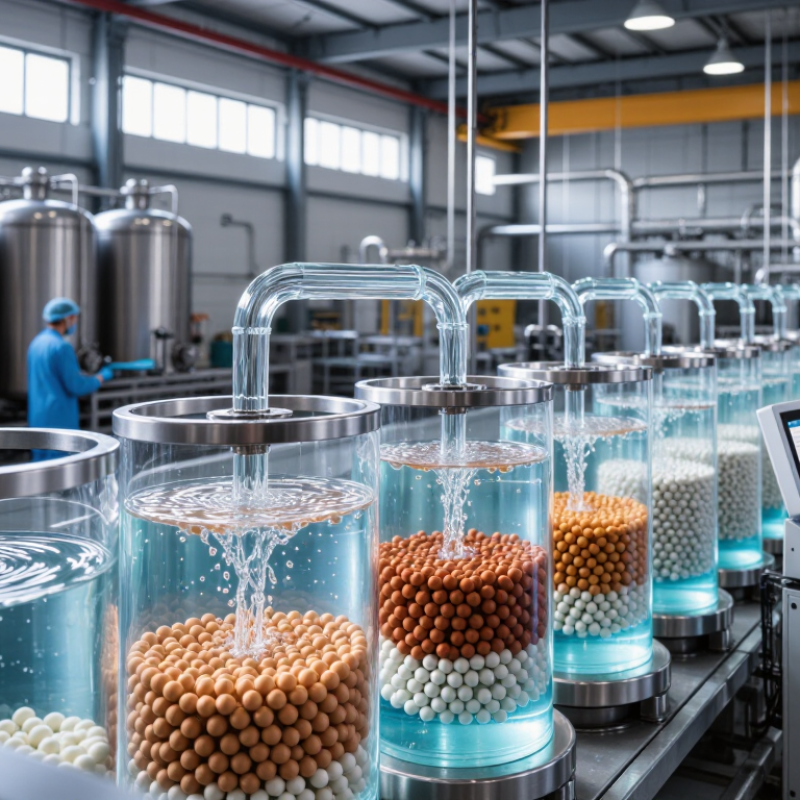
Top 10 Ion Exchange Resin Manufacturers Worldwide

Ion Exchange Resins: Core Principles and Main Applications

Ion exchange resins are porous polymer beads with fixed charged groups on their surfaces. These groups attract dissolved ions and exchange them for ions attached to the resin. As water flows through a bed, calcium or magnesium may be captured in exchange for sodium. Other resin types remove nitrate, metals, or dissolved mineral salts. Small details matter. Feed pH, competing ions, and contact time all affect performance. The theory is tidy; real water is not.

This chemistry supports water softening, demineralization, and selected wastewater treatment processes. In demineralization, cation and anion beds work in sequence to reduce dissolved salts. Operators track outlet conductivity and pressure drop to spot breakthrough or fouling. Resins can also recover useful ions from process streams, though results depend on the stream’s composition. They are not magic. Suspended solids can clog a bed, while organic matter may reduce capacity. Regeneration restores many resins, but creates a concentrated waste stream that needs careful handling. Selecting a resin therefore means testing actual water, not relying on a product description alone. That step is easy to underestimate.


How Global Ion Exchange Resin Manufacturers Are Evaluated

Global ion exchange resin manufacturers should be evaluated against the water or process conditions their products must handle. A resin that performs well in a laboratory may behave differently with variable feedwater. Review ionic capacity, selectivity, bead size, and resistance to repeated regeneration. Ask for test data that reflects operating temperature, flow rate, and contaminant levels. Small details matter.

Manufacturing consistency is another key measure. Buyers can examine batch records, quality controls, and traceability from raw material to finished resin. Clear guidance on storage, installation, and regeneration also signals practical expertise. Technical support should include useful answers, not only product brochures. When possible, compare samples using the same test protocol. No scorecard is perfect.

Reliability extends beyond initial performance. Consider expected service life, replacement lead times, packaging, and the supplier’s ability to maintain consistent specifications. Environmental information, such as regeneration requirements and spent-resin handling guidance, can help teams assess wider operating impacts. Check claims against documented evidence, and distinguish verified results from estimates. Some data may be self-reported; that deserves a closer look. A careful evaluation balances technical performance, dependable supply, and support over the resin’s full operating cycle.

Top Ion Exchange Resin Manufacturers Worldwide

Top Ion Exchange Resin Manufacturers Worldwide

Leading ion exchange resin manufacturers are judged by more than production volume. Buyers need consistent bead size, documented capacity, and dependable performance across repeated regeneration cycles. In a treatment plant, small quality differences can mean earlier breakthrough, extra rinse water, or an unexpected shutdown. Details matter.

Market reports indicate continued demand, but their estimates vary. Grand View Research valued the global ion exchange resin market at about USD 2.3 billion in 2023 and projected 5.6% annual growth through 2030. Fortune Business Insights estimated the 2023 market at about USD 1.98 billion, forecasting 5.4% annual growth through 2032. Different scopes and methods can explain the gap; these figures are not a manufacturer ranking. Still, they point to expanding use in water treatment, food processing, and chemical production.

For a worldwide comparison, assess technical support alongside resin specifications. Ask manufacturers for water-quality test data, operating limits, and guidance on disposal or replacement. Check how their products perform with the actual feedwater, not only ideal laboratory samples. That takes effort. It can also expose a weak fit before a plant commits to a full-scale installation. The best supplier on paper may not be best for a particular site.

Top 10 Ion Exchange Resin Manufacturers Worldwide

This chart compares representative total exchange-capacity ranges across ten common ion exchange resin types. It does not rank manufacturers; actual specifications vary by product, ionic form, and test method.

Values are indicative typical ranges in equivalents per liter (eq/L) of settled resin, rather than specifications for any particular manufacturer or brand.

Resin Technologies and Industries Served by Leading Manufacturers

Leading ion exchange resin manufacturers develop materials around specific separation needs. Many use styrene-divinylbenzene or acrylic polymer matrices, then add functional groups that attract selected ions. Strong-acid cation resins can soften water, while anion resins help remove dissolved salts. Chelating resins target metals more selectively. Small design changes matter. Bead size, pore structure, and crosslinking affect capacity, flow, and resistance to fouling.

These differences shape the industries served. Municipal and industrial water plants use resin beds to reduce hardness or produce high-purity process water. Pharmaceutical facilities may require carefully controlled polishing stages, with documented extractables and consistent performance. Food processors use suitable resins for tasks such as demineralization, subject to product-contact requirements. In hydrometallurgy, selective resins can help recover metals from process streams. The right choice depends on feed chemistry, not just a product label.

Good manufacturers support selection with technical data, operating guidance, and testing under realistic conditions. A resin that performs well in a laboratory may behave differently when suspended solids or organic matter enter the bed. Watch pressure drop. Regeneration also affects operating cost and waste volume, so capacity alone is an incomplete measure. Specifications can look precise, yet real water chemistry changes. That deserves more attention than it sometimes gets.

Market Trends and Considerations for Choosing a Supplier

Ion-exchange resin demand is being shaped by tighter water-quality targets, industrial reuse, and high-purity process needs. Grand View Research’s 2024 Ion Exchange Resins Market report estimated global sales at about US$2.3 billion in 2023, with growth expected through 2030. The UNESCO World Water Development Report 2024 notes that 2.2 billion people lacked safely managed drinking water in 2022. These figures point to sustained demand, but they do not identify the right resin for every plant. Feed-water chemistry matters more than market momentum.

When comparing suppliers, ask for performance data under conditions close to your own: inlet ionic load, temperature, flow rate, and regeneration method. Confirm whether the proposed resin is strong-acid cation, weak-base anion, chelating, or another suitable type. Request particle-size distribution, exchange capacity, leachables data, and guidance on bed depth and pressure drop. Small details matter. Compare delivered cost per treated volume, not just price per liter; service life and rinse-water use can change the calculation. Ask how batches are tested and how technical support handles early breakthrough. A sample trial helps, though one short pilot may not reveal seasonal feed-water changes. That limitation is easy to underestimate.

Kontaktbox-Frau

  • CNC-STEP – Quick contact