



Why Choose 304 Stainless Plate for Global Projects?
Global projects face demanding conditions: rain, humidity, food acids, cleaning chemicals, and long transport routes. 304 Stainless Plate offers a practical response because it combines corrosion resistance, strength, and fabrication flexibility. It contains chromium and nickel, creating a passive surface that can repair itself when oxygen is available. This makes it suitable for tanks, architectural panels, kitchen equipment, machinery covers, and general industrial structures.
Materials scientist Dr. Michael F. Ashby offers a useful design reminder: “Materials are the stuff of design.” His statement matters here. A plate should not be selected by price alone. Engineers must examine temperature, chloride exposure, forming requirements, welding methods, surface finish, and expected service life. A properly specified 304 Stainless Plate can arrive at a project site with a bright No. 4 finish, clean edges, and certified thickness. Those details affect installation quality.
Yet 304 is not invincible. High salt concentrations, stagnant moisture, and marine splash zones may cause pitting or staining. That limitation deserves attention. In some coastal or chemical environments, 316 stainless steel may offer better protection. Project teams should review mill certificates, test reports, welding procedures, and inspection records before approval. Real experience often reveals small failures: trapped water behind a panel, carbon-steel contamination from a wire brush, or poor drainage near a joint. These mistakes are preventable, but they still occur. Choosing 304 Stainless Plate wisely means balancing performance, availability, cost, and local service conditions.
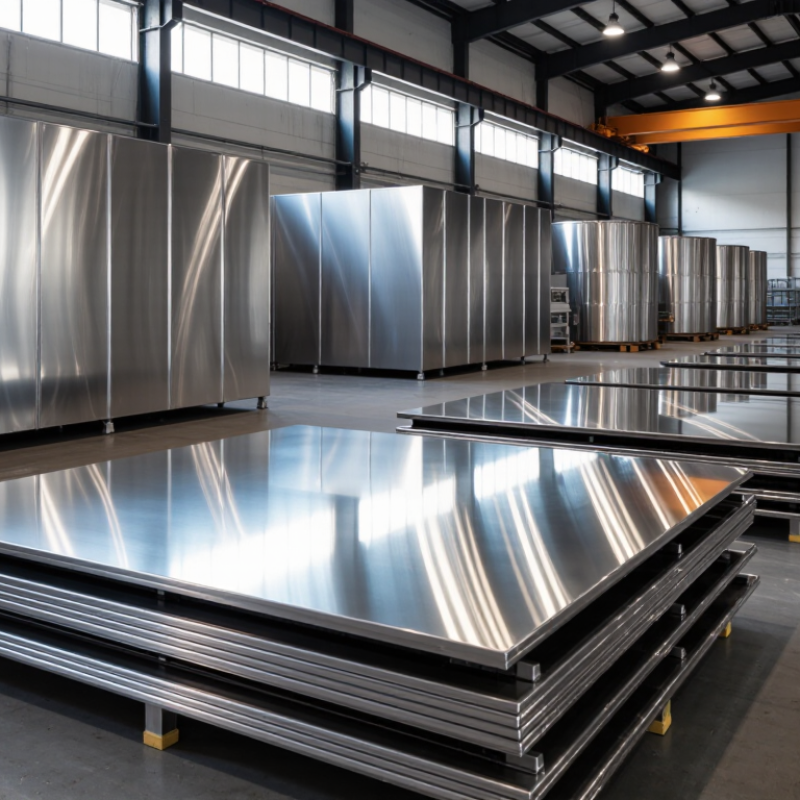
What Is 304 Stainless Plate?
304 stainless plate is a flat, rolled product made from austenitic stainless steel. It typically contains about 18% chromium and 8% nickel, although exact chemistry depends on the applicable specification. Chromium creates a passive oxide layer that helps resist rust. Nickel improves toughness and supports performance across changing temperatures. It is not magnetic in its annealed condition, though forming or machining may create slight magnetism.
In fabrication practice, 304 plate is valued because it can be cut, formed, and welded without unusual procedures. Its clean surface suits food-processing areas, architectural panels, tanks, and general industrial equipment. I have seen plate selected for outdoor frames where rain, handling, and repeated cleaning were expected. Surface finish matters. A rough finish can hold dirt and moisture, even when the alloy itself performs well.
The material is not a universal solution. High chloride exposure, such as seawater spray, may cause pitting and should prompt a careful material review. Welding also deserves attention, because prolonged heating can reduce corrosion resistance near the weld. For demanding welded assemblies, 304L may be more suitable. Thickness terms vary by market, so buyers should confirm dimensions, tolerances, heat numbers, test certificates, and the governing standard. That small check prevents expensive misunderstandings.
Why Choose 304 Stainless Plate for Global Projects? - What Is 304 Stainless Plate?
| Data Dimension | Typical Data for 304 Stainless Plate | Project Relevance |
|---|---|---|
| Material Designation | AISI 304; UNS S30400; EN 1.4301 | These designations identify the same general austenitic stainless-steel grade under commonly used American and European systems. |
| Product Form | Flat-rolled stainless-steel plate | It is supplied as a flat product and can be cut, formed, welded, machined, or fabricated for structural and process equipment applications. |
| Primary Alloy Family | Austenitic stainless steel | The austenitic structure provides good ductility, weldability, and toughness over a broad range of service conditions. |
| Chromium Content | 18.00–20.00 wt.% | Chromium forms a thin, self-healing passive oxide layer that provides the material's basic corrosion resistance. |
| Nickel Content | 8.00–10.50 wt.% | Nickel stabilizes the austenitic structure and supports ductility, toughness, and corrosion resistance. |
| Carbon Content | Maximum 0.07 wt.% | The controlled carbon level supports weldability. For more demanding welded construction, 304L may be selected because it has a lower carbon limit. |
| Other Composition Limits | Mn ≤ 2.00%; Si ≤ 1.00%; P ≤ 0.045%; S ≤ 0.030%; N ≤ 0.10% | Actual limits depend on the applicable product specification and material certificate. |
| Minimum Tensile Strength | 515 MPa approximately 75 ksi | Typical minimum requirement for annealed plate under ASTM A240/A240M; the governing standard should be confirmed for each project. |
| Minimum Yield Strength | 205 MPa approximately 30 ksi | This value is commonly specified at 0.2% offset for annealed 304 plate. |
| Minimum Elongation | 40% in 50 mm typical ASTM requirement | High elongation supports forming and fabrication, although actual results vary with product thickness and testing direction. |
| Density | Approximately 8.00 g/cm³ | This value is useful for estimating shipping weight, structural loads, and material quantities. |
| Melting Range | Approximately 1,400–1,450 °C | The range is relevant to welding, heat treatment, thermal processing, and high-temperature design calculations. |
| Magnetic Behavior | Generally non-magnetic when annealed | Cold working or forming can induce some magnetism. Magnetic response should not be used as the sole method of grade identification. |
| Corrosion Resistance | Good resistance in many atmospheric and mildly corrosive environments | Performance depends on temperature, chloride concentration, surface condition, crevices, deposits, and cleaning practices. |
| Chloride Limitation | Not the preferred choice for severe chloride exposure | Pitting and crevice corrosion can occur in seawater, concentrated chlorides, and warm chloride-bearing environments; a molybdenum-bearing grade may be more suitable. |
| Weldability | Excellent for common fusion-welding processes | Shielded metal arc, gas metal arc, gas tungsten arc, and resistance welding are commonly used. Heat tint should be removed and the surface restored when corrosion performance matters. |
| Formability | Very good, with work-hardening tendency | The alloy can be bent, rolled, and deep-drawn, but springback and increased hardness after cold work should be considered in tooling design. |
| Machinability | Good with appropriate stainless-steel tooling and feeds | Work hardening makes sharp tools, controlled cutting conditions, and sufficient cooling important during machining. |
| Common Surface Finishes | 2B, No. 1, brushed, polished, and custom-finished surfaces | The required finish should be specified according to appearance, cleanability, friction, reflectivity, and corrosion-service needs. |
| Typical Applications | Food-processing equipment, kitchen equipment, tanks, piping components, architectural panels, pharmaceutical equipment, and general fabrication | The broad application range results from the combination of corrosion resistance, strength, formability, weldability, and global availability. |
| Common Product Standard | ASTM A240/A240M for stainless-steel plate, sheet, and strip for pressure vessels and general applications | Other projects may require EN, JIS, or other national standards. Chemical, mechanical, dimensional, inspection, and documentation requirements should be stated in the purchase specification. |
| Inspection Documentation | Material test certificate, heat number, chemical analysis, mechanical test results, dimensions, and surface condition | Traceability requirements vary by project. Certificates should correspond to the supplied heat and applicable standard. |
| Key Selection Advantage | Balanced performance and broad international specification coverage | 304 is often selected when a project needs a widely recognized stainless grade with reliable fabrication performance and general-purpose corrosion resistance. |
| Important Design Caution | Grade selection must match the actual service environment | Temperature, chlorides, acids, weld condition, stress, surface finish, cleaning chemicals, and regulatory requirements should be reviewed before final selection. |