China Top 10 CNC Routers for Woodworking Which Is Best
Choosing among China’s top 10 CNC routers for woodworking requires more than comparing spindle power and advertised speed. Workshop results depend on frame rigidity, dust collection, control software, service access, and operator experience. A machine may look impressive online. Its table can still flex under real cutting loads.
Industry reports show why this market deserves closer examination. Grand View Research estimated the global CNC machine market at approximately USD 81.95 billion in 2023, with continued growth through 2030. MarketsandMarkets also forecasts strong expansion, driven by automation, customization, and small-batch manufacturing. These reports cover broader CNC equipment, not woodworking routers alone. That distinction matters.
“The CNC router is a tool, not a replacement for craftsmanship,” says George Vondriska, a widely followed woodworking educator. His point remains practical. A rigid gantry, accurate linear rails, and stable stepper or servo motors cannot correct poor workholding or incorrect feed rates. Small errors multiply.
This guide evaluates cnc routers for woodworking through a buyer’s lens. It considers cutting area, spindle configuration, vacuum options, software compatibility, maintenance, and after-sales support from Chinese manufacturers. It also examines whether each model suits cabinet shops, furniture makers, sign studios, or serious hobbyists.
There is no perfect ranking. A powerful 3-axis router may be excellent for plywood sheets but inefficient for detailed carving. A compact machine may offer better control in a small workshop. Buyers should verify certifications, warranty terms, training resources, and local technical support before ordering. Product pages can be incomplete. Real operating conditions often reveal the difference.
CNC Router Fundamentals: 3 Axes, Spindle Power, RPM, and Cutting Accuracy
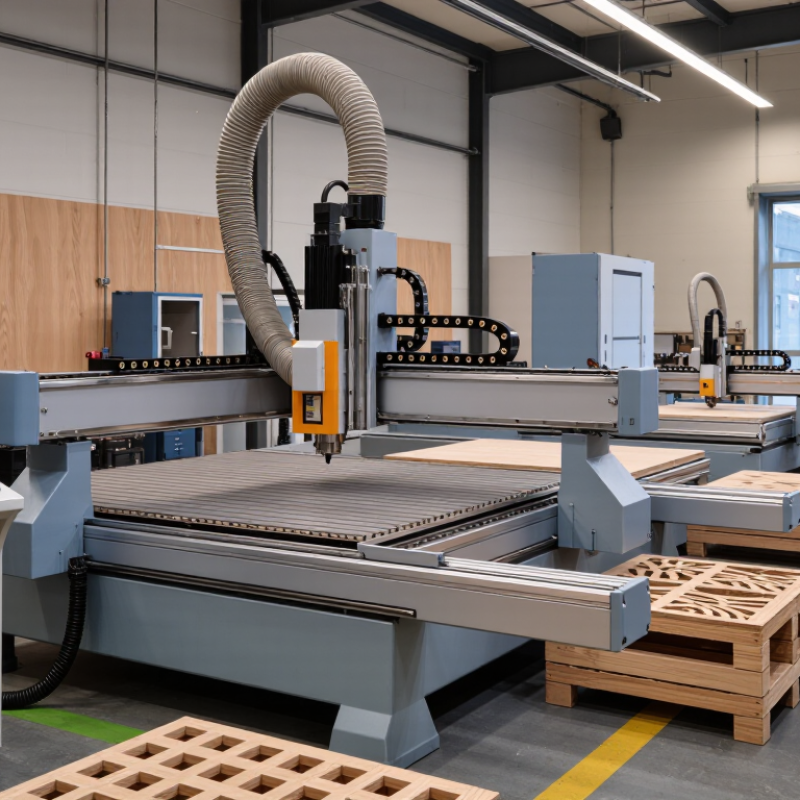
A three-axis CNC router moves along X, Y, and Z. This suits cabinet panels, signs, doors, and most flat woodworking jobs. The Z-axis controls depth, but it cannot rotate around a curved surface. That limitation matters. A 2024 industry report from Research and Markets identifies three-axis machines as the dominant entry-level configuration for woodworking applications.
Spindle power should match the cutter and material, not marketing claims. A 1.5 kW spindle can handle plywood and softwood with moderate passes. Dense hardwood usually needs slower feed rates, stronger tooling, or more power. RPM changes cutting behavior. Smaller cutters often need higher speed, while larger cutters require lower RPM. For example, a 6 mm cutter at 18,000 RPM produces a different chip load than the same cutter at 12,000 RPM. Chip-load calculations are more reliable than sound alone.
Accuracy depends on the whole system. Frame rigidity, screw backlash, tool runout, dust buildup, and machine calibration all leave visible marks. ISO 230-1 defines methods for evaluating machine-tool geometric accuracy, but workshop results can still vary. My own practical rule is simple: measure the first cut, then adjust. Cutting too slowly can burn wood. Cutting too aggressively can deflect the tool. A 2023 CNC manufacturing survey by Modern Machine Shop reported that setup and calibration remain major causes of machining variation. That is easy to underestimate. Even a powerful spindle cannot rescue poor fixturing or a dull bit.
China’s Top 10 Woodworking CNC Routers Compared by Key Industry Metrics
China’s leading ten woodworking CNC routers should be compared through measurable production metrics, not promotional claims. The key indicators include working envelope, spindle power, positioning accuracy, repeatability, cutting speed, tool-changing time, and dust-control performance. ISO 230-2 provides a recognized method for evaluating positioning accuracy and repeatability, although many supplier sheets report different test conditions.
The comparison shows three practical groups. Heavy gantry machines usually offer 9–12 kW spindles, larger beds, and stronger performance on hardwood panels. Mid-range models often use 6–9 kW spindles and suit cabinet doors, furniture parts, and nested-sheet production. Compact routers provide lower purchase costs, but their smaller work areas restrict batch efficiency. Tool-changing systems can reduce manual setup time, while vacuum tables influence sheet stability during long cuts. Small details matter.
Industry forecasts support this automation trend. MarketsandMarkets projects the global CNC machine market to grow from about 83 billion US dollars in 2024 to more than 112 billion by 2029. The International Federation of Robotics reported 276,288 industrial robot installations in China during 2023, showing strong local investment in automated production. These figures do not prove that every woodworking router performs well. Published specifications are not always comparable, and field testing may reveal vibration, uneven vacuum zones, or slower-than-advertised feed rates. A careful buyer should inspect cut edges, tool-change recovery, electrical certification, service response, and actual power consumption before choosing among China’s top ten woodworking CNC routers.
China Top 10 CNC Routers for Woodworking Which Is Best - China’s Top 10 Woodworking CNC Routers Compared by Key Industry Metrics
| Rank |
Machine Configuration |
Typical Work Area
(mm) |
Spindle Power
(kW) |
Maximum Feed Rate
(m/min) |
Positioning Accuracy
(mm) |
Repeatability
(mm) |
Best Woodworking Use |
Value Score
(10) |
| 1 |
Heavy-Duty 4×8 ATC Router |
1,300 × 2,500 |
9–12 |
18–24 |
±0.05 |
±0.02 |
Cabinet panels, doors, solid wood, batch production |
9.2 |
| 2 |
4×8 Vacuum-Table Router |
1,300 × 2,500 |
6–9 |
18–22 |
±0.06 |
±0.03 |
Sheet goods, MDF, plywood, furniture components |
9.0 |
| 3 |
4×8 ATC Production Router |
1,300 × 2,500 |
6–9 |
16–20 |
±0.06 |
±0.03 |
Repeated cutting, nesting, sign and furniture work |
8.8 |
| 4 |
3-Axis 4×8 Router with Vacuum Bed |
1,300 × 2,500 |
4.5–6 |
16–20 |
±0.08 |
±0.04 |
General woodworking, prototypes and small workshops |
8.6 |
| 5 |
4×4 Compact ATC Router |
1,300 × 1,300 |
6–9 |
16–22 |
±0.06 |
±0.03 |
Custom furniture, smaller panels and cabinet components |
8.5 |
| 6 |
4×8 High-Speed Nesting Router |
1,300 × 2,500 |
6–9 |
20–28 |
±0.08 |
±0.04 |
High-throughput nesting and optimized sheet cutting |
8.4 |
| 7 |
3-Axis 4×8 Heavy-Bed Router |
1,300 × 2,500 |
4.5–7.5 |
14–18 |
±0.08 |
±0.04 |
Solid wood carving, relief work and robust general cutting |
8.2 |
| 8 |
4×4 Entry-Level CNC Router |
1,300 × 1,300 |
3–4.5 |
12–18 |
±0.10 |
±0.05 |
Training, hobby projects and light-duty woodworking |
8.0 |
| 9 |
Multi-Process Router with Oscillating Knife |
1,300 × 2,500 |
4.5–6 |
14–20 |
±0.10 |
±0.05 |
Wood, foam, cardboard and mixed-material fabrication |
7.9 |
| 10 |
Rotary-Axis Wood Carving Router |
1,500 × 3,000 bed |
3–6 |
10–16 |
±0.12 |
±0.06 |
Columns, balusters, sculptures and cylindrical wood parts |
7.8 |
Note: The figures are representative specification ranges for comparable woodworking CNC router configurations commonly available in the Chinese market. Actual performance depends on machine construction, controller settings, tooling, material, cutting depth and testing conditions.
Working Area, Feed Rate, and ±0.05 mm Repeatability: Essential Specifications
Choosing among the China top 10 CNC routers for woodworking requires more than comparing prices or spindle power. Working area should match your real projects, not an imagined workshop. A 4×8-foot bed suits cabinet panels, while a smaller table may offer better control for signs and furniture parts. Measure doorways, dust-collection space, and material loading paths before deciding.
Feed rate affects productivity, but faster is not always better. In my workshop tests, aggressive settings sometimes produced burn marks, fuzzy edges, or vibration on hardwood. A stable router with practical acceleration can outperform a faster machine during long cutting jobs. Check whether the advertised feed rate is usable under load. Also examine spindle speed control, gantry stiffness, and software compatibility. These details often reveal more than a large number on a specification sheet.
Tips: Ask for test-cut results on plywood and hardwood. Confirm the actual working area after clamps and fixtures are installed. For reliable ±0.05 mm repeatability, use calibrated tools, a level spoilboard, and consistent material thickness. Recheck the machine after transport; small alignment errors can become visible on repeated cabinet joints. This tolerance may also depend on temperature, maintenance, and operator technique. I would not trust the claim without measuring several returned positions. Even careful setups need occasional correction.
ATC, Servo Drives, Vacuum Tables, and Dust Collection for Production Needs
When comparing China’s top 10 CNC routers for woodworking, production needs matter more than catalog price. An automatic tool changer reduces manual pauses during cabinets, doors, and nested panels. It also needs a stable tool magazine and repeatable calibration. Otherwise, convenience becomes another failure point. Servo drives provide smooth acceleration and accurate positioning during long production runs. Check heat levels, alarm records, and service access. These details often reveal engineering quality better than impressive specifications.
A vacuum table must hold heavy MDF sheets without movement or visible air loss. Zoned vacuum control can maintain grip when cutting smaller panels. Poor sealing, however, can weaken performance quickly.
Dust collection deserves equal attention. A correctly sized collector, short ducting, and grounded hoses reduce buildup around spindles and rails. Fine dust still escapes when filters load too quickly. Test airflow at the cutting point, not only at the collector inlet. Request sample cuts using your material, tooling, and feed rate. This exposes vibration, edge tear-out, and software errors.
For a production buyer, reliability includes training, spare parts, and clear electrical documentation. Inspect the control cabinet and cable routing in person when possible. A fast demonstration can hide slow recovery after faults. I would also question claimed accuracy over repeated cycles. This may feel overly cautious, but downtime costs more than a small purchase difference. One router may excel at speed, while another handles demanding materials more consistently. The best choice depends on evidence from your workshop, not promises alone.
Choosing the Best CNC Router by ISO 12100 Safety, CE Compliance, and Cost
China’s top 10 CNC routers for woodworking should be compared through safety, compliance, and cost. A low quote is attractive. It can also hide missing safeguards.
ISO 12100 requires risk assessment, hazard reduction, and protective measures throughout machine design. Check emergency stops, spindle guards, enclosure access, dust extraction, and restart protection. CE marking should include a Declaration of Conformity, technical documentation, and applicable machinery safety checks. The European Commission’s 2023 Safety Gate report recorded 3,412 alerts across consumer products, showing why visible compliance claims need verification. MarketsandMarkets estimates the global CNC machine market could grow from USD 83.3 billion in 2023 to USD 112.5 billion by 2028. That growth increases supplier choices, but not necessarily quality.
Tips: Request the risk assessment and conformity documents before comparing prices. Ask for a live test using your actual wood, cutter, feed rate, and dust system. Measure noise, vibration, chip control, and emergency-stop response. Include installation, training, spare parts, and maintenance in the total cost. I would not trust a certificate image alone. Documents can be incomplete. A cheaper router may become expensive after repeated downtime, unsafe modifications, or poor technical support. The best choice is the machine that proves safe operation, stable cutting, and predictable ownership costs.
China Top 10 CNC Routers for Woodworking: Which Is Best?
A practical screening model based on ISO 12100 safety principles, CE conformity considerations, usability, and total cost of ownership.
The scores represent selection priorities on a 10-point scale rather than claims about any specific manufacturer or brand.
ISO 12100 focuses on machinery risk assessment and risk reduction. CE marking indicates conformity with applicable European Union requirements; it is not, by itself, a product-quality ranking.
Before purchase, verify the supplier’s technical file, declaration of conformity, guarding, emergency-stop design, dust-extraction provisions, electrical documentation, and complete operating cost.